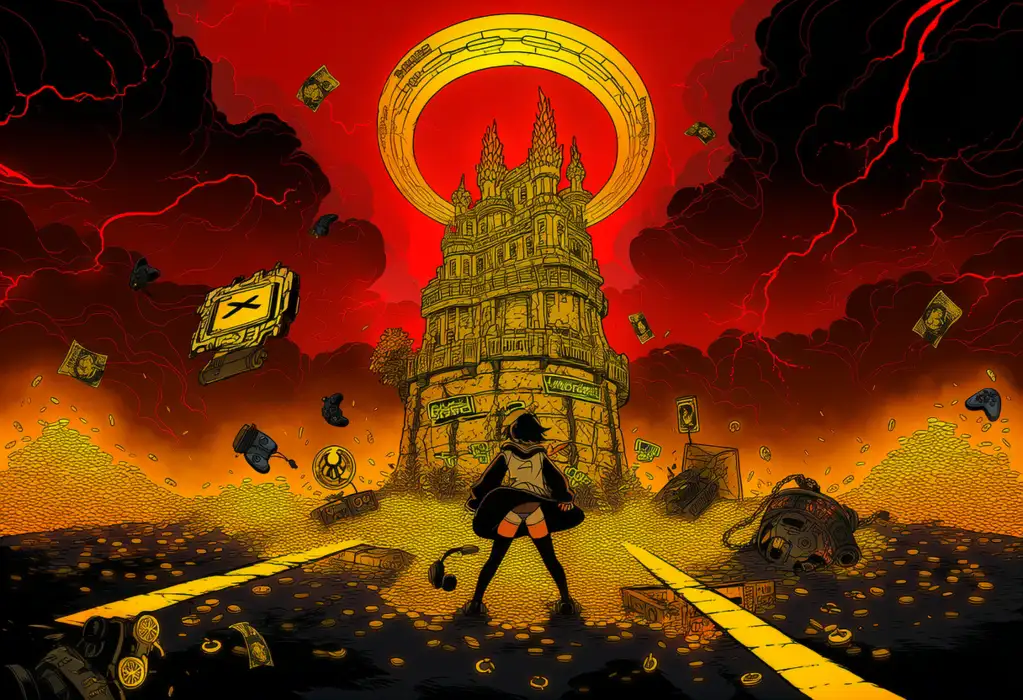
Highguard launched on January 26, 2026, and died on March 12. Forty-five days. That’s shorter than most Netflix shows last in your queue. It peaked at 97,000 concurrent Steam players, then hemorrhaged 80% of them within 24 hours and 90% within a week. And here’s the part that should make every gamer furious: its monetization was actually fair by free-to-play standards. No loot boxes. All heroes, maps, and modes free. Cosmetic purchases only. And it still cratered.
I’ve been writing about gaming’s broken business models for years, and the Highguard backlash isn’t just about one failed game — it’s the clearest proof yet that the entire free-to-play model is fundamentally broken, not just the predatory versions of it. If even a “player-friendly” F2P game can’t survive, what does that tell us about the model itself?
Bookmark this one. Share it with someone who still thinks free-to-play is a good deal.
The Highguard Backlash: A 45-Day Death Spiral
Let me walk you through the timeline, because the sheer speed of this collapse is staggering. In December 2025, Highguard got the coveted closing spot at The Game Awards — reportedly offered for free by Geoff Keighley himself [VERIFY]. Former Apex Legends and Titanfall developers at Wildlight Entertainment were pitching a 3v3 “raid shooter” that they clearly believed would be the next big thing. The internet’s response? Immediate mockery. Players compared it to Concord, the Sony-published disaster that shut down after just 14 days in August 2024.
Then came launch day, January 26, 2026. Highguard peaked at roughly 97,000 concurrent players on Steam. Not bad, right? Within 24 hours, that number dropped to around 19,000 — an 80% collapse in a single day. Within a week, per Bloomberg’s reporting via GamesRadar, 90% of all players had vanished. Steam reviews sat at “Mostly Negative” from day one. Not “Mixed.” Not “Mostly Positive.” Negative. From the start.
On March 12, 2026, Wildlight pulled the plug. In the 24 hours before shutdown, the game peaked at just 784 players. Twenty-five people were reportedly still playing even after the servers went offline — which is either dedication or a sad commentary on how little else they had going on. The entire lifespan: 45 days from launch to death.
This isn’t just a story about a bad game failing. As I wrote in my piece on the gaming industry crisis of 2026, this is part of a systemic pattern of live-service failures, mass layoffs, and studios chasing F2P gold only to find ash. Highguard is the latest casualty, but it won’t be the last.
“Fair” Monetization and Still Failed — That’s the Problem
Here’s what makes the Highguard backlash different from every other F2P disaster story, and why I think it matters more than Concord or XDefiant: Highguard’s monetization was actually reasonable.
Wildlight made all heroes, maps, and game modes completely free. No loot boxes. No pay-to-win mechanics. The only things behind a paywall were cosmetic skins. The studio even publicly promised it wouldn’t “bombard players with constant ads” and wanted to “leave you the hell alone.” They used a three-currency system — Warden Credits (earned through play), Highguard Gold (premium real-money currency), and War Chests (battle pass) — but the core gameplay was entirely accessible without spending a dime.
ComicBook.com ran a piece titled “Highguard Doesn’t Deserve All the Hate It’s Getting,” arguing that the game had “managed to avoid much of the predatory monetization seen in other live-service titles.” And they weren’t wrong! Compared to the loot-box hellscape of most F2P games, Highguard’s store was practically charitable.
And it still failed.
That’s the part that should terrify everyone in the industry. If a game with fair monetization, experienced developers, and a free-to-play model that genuinely respects players’ time and wallets can’t survive, then the problem isn’t predatory microtransactions — it’s the entire F2P model. The model demands constant engagement, whale spending, and a player base large enough to sustain a live-service economy. When you strip away the manipulation, you’re left with a game that still needs thousands of people spending real money on digital costumes to keep the lights on. That’s not a sustainable business — it’s a prayer dressed up as a business plan.
The F2P Playbook: Hype, Launch, Crash, Shut Down
I’ve watched this same script play out so many times I could write it from memory. Here’s the free-to-play playbook, and see if it sounds familiar:
Step 1: Hype. Get a big reveal at a major event. Promise the world. “We’re different.” “We respect players.” “This isn’t like those other F2P games.” Highguard checked every box — The Game Awards reveal, ex-Respawn developers, promises of fair monetization. The marketing was textbook.
Step 2: Launch. A big day-one player spike that makes everyone think the game is a hit. Highguard hit 97k. Concord had its moment too, albeit smaller. Every F2P game gets that initial curiosity bump. Players download because it’s free, and curiosity costs nothing.
Step 3: Crash. Players realize the game doesn’t offer enough to keep them coming back. The F2P model demands constant content updates, seasonal events, and battle pass progression — but if the core gameplay loop isn’t compelling enough, no amount of live-service scaffolding can save it. Within days, the player base evaporates. Highguard lost 80% in 24 hours. That’s not a slow decline. That’s a mass exodus.
Step 4: Scramble. Developers panic. Some lash out at the community — like the Wildlight developer who went on a now-deleted “blame the gamers” tirade on X, calling out players and content creators for the game’s failure. This always backfires. Always.
Step 5: Shut down. The publisher pulls funding. Servers go dark. Developers lose their jobs. Players who spent money on skins and battle passes are left with nothing. The cycle begins again with the next “revolutionary” F2P game.
Concord died in 14 days. XDefiant lasted about a year before Ubisoft pulled the plug. Sony cancelled six or more live-service games following Concord’s failure [VERIFY]. As Polygon reported, “Highguard layoffs show the free-to-play model isn’t working anymore.” They’re right, and it’s about time someone said it plainly.
Blame the Gamers: Wildlight’s Spectacular Self-Destruction
One of the most infuriating chapters in the Highguard saga was the developer response. When the backlash hit — and it hit hard — a Wildlight developer took to X (formerly Twitter) to publicly blame gamers and content creators for the game’s failure. The post was deleted, but not before it was screenshotted, shared, and memed into oblivion.
Let me be clear about something: I have sympathy for the individual developers at Wildlight. These are people who poured years of their lives into a project, and watching it fail publicly is brutal. Most of the team was laid off after Tencent withdrew funding. Only about 20 developers remained after the cuts. That’s a human tragedy, and I don’t want to minimize it.
But blaming the players? That’s not just tone-deaf — it’s a fundamental misunderstanding of how the F2P market works. Players don’t owe you their time. They don’t owe you a fair shake. When your game launches into a market saturated with free-to-play shooters, you have about five minutes to convince someone it’s worth their time. Highguard didn’t do that. The Bloomberg investigation, as reported by The Ringer, revealed that studio leaders were “convinced they had another Apex Legends on their hands.” That hubris is the real story here.
IGN ran a piece asking “When Did It Become Trendy to Hate on a New Game?” — a legitimate question, but one that misses the point. The backlash wasn’t just trendy; it was earned. A game that loses 80% of its players in 24 hours has a retention problem, not a PR problem. You can’t gaslight players into enjoying something they don’t enjoy. And as I wrote about why gamers are right to be angry about AI slop, the industry keeps expecting players to just accept whatever it serves up — and then acts shocked when they don’t.
Tencent’s Secret Funding and the Illusion of Independence
Here’s a detail that should bother everyone: Highguard was secretly funded by Tencent through TiMi Studio Group. This wasn’t disclosed at launch. Players downloaded what they thought was an indie game from passionate ex-Respawn developers, and it was actually backed by one of the largest gaming conglomerates on the planet.
Now, I’m not saying Tencent funding automatically makes a game bad. But the lack of transparency is the issue. When Wildlight said they “wanted to build a store that we want to see ourselves as players,” they were saying the quiet part loud — the F2P model requires a store, period. The question was never whether there would be monetization, but how aggressive it would be. And even with Tencent’s deep pockets behind them, even with the softest possible approach, the math didn’t work.
This connects to a broader issue I’ve been tracking. As I wrote about the gaming industry crisis of 2026, the consolidation of power in the hands of a few massive corporations — Tencent, Sony, Microsoft — is reshaping the industry in ways that hurt both developers and players. Studios like Wildlight become dependent on publisher funding, and when the numbers don’t meet expectations, the plug gets pulled. The developers who built the game are the ones who suffer most.
Tencent withdrew funding after Highguard failed to meet performance benchmarks. Mass layoffs followed. The studio was gutted. About 20 developers remained from what had been a full team. This is the F2P cycle: corporate money flows in, expectations inflate, reality disappoints, and the humans who actually made the game are left holding the bag while executives move on to the next bet.
Why the F2P Model Is Broken Beyond Repair
Let me spell this out clearly, because I think the Highguard backlash has illuminated something that the gaming industry keeps pretending isn’t true: the free-to-play model is fundamentally broken.
The F2P market was valued at $62.32 billion in 2025, projected to reach $71.45 billion in 2026 [VERIFY]. Those numbers sound impressive, but they mask a brutal reality: 5% of players — the so-called “whales” — are responsible for 65% of all in-app purchase revenue, according to the Unity 2025 Gaming Report [VERIFY]. Two percent of players can drive up to 90% of mobile game revenue. The average gamer spends $147 annually on in-game purchases, up from $132 the year before.
This isn’t a business model. It’s an exploitation model. F2P games survive by extracting disproportionate amounts of money from a tiny percentage of vulnerable players. When Highguard tried to be “fair” about it, it discovered what should have been obvious: if you’re not aggressively manipulating your players into spending, you can’t sustain a live-service game. The fairness and the model are fundamentally incompatible.
The F2P model demands infinite growth. It demands that players keep coming back, keep grinding, keep spending. It demands seasonal content, battle passes, limited-time events, FOMO-driven cosmetics. And when a game like Highguard tries to strip away the manipulation while keeping the model, it discovers that the model is the manipulation. You can’t have “fair F2P” because F2P without manipulation is just a free game that nobody pays for — and free games that nobody pays for don’t have servers, content updates, or developers.
I’m not saying every F2P game is doomed. Fortnite and Apex Legends exist. But they’re the exceptions that prove the rule — massive, established games with enormous player bases that can sustain themselves on cosmetic revenue alone. For every Fortnite, there are dozens of Highguards, Concords, and XDefiants that crash and burn. The model works for the top 1% of games and destroys everything else in its path.
If you want to see what a healthier gaming landscape looks like, check out my list of the best games of 2026 — most of them aren’t F2P, and most of them will still be playable in five years. Can’t say the same for Highguard, can we?
Frequently Asked Questions
Why did Highguard shut down so quickly?
Highguard lost 90% of its players within a week of launch. With only 784 peak players in its final 24 hours, the game couldn’t sustain the live-service model that F2P games require. Tencent withdrew funding after the game failed to meet performance benchmarks, triggering mass layoffs and the eventual shutdown on March 12, 2026 — just 45 days after launch.
Was Highguard’s monetization actually predatory?
Surprisingly, no — and that’s exactly the point. Highguard offered all heroes, maps, and modes for free, with no loot boxes and cosmetic-only purchases. It was one of the most player-friendly F2P monetization models in recent memory. The fact that it still failed proves that the problem isn’t just predatory microtransactions — it’s the entire F2P model that demands unsustainable player engagement and spending to survive.
What is the “whale” problem in F2P games?
In F2P gaming, “whales” are the small percentage of players who spend enormous amounts of money on microtransactions. Industry data shows that roughly 5% of players account for 65% of all in-app purchase revenue, and 2% of players can drive up to 90% of mobile game revenue. This means F2P games are designed to extract disproportionate spending from a vulnerable minority, not to provide fair value to the average player.
How is Highguard different from other F2P failures like Concord?
Concord was a premium-priced game ($40) that shut down after just 14 days. Highguard was free-to-play with fair monetization, yet it still failed. The key difference is that Concord’s failure could be blamed on its price point and lack of player interest, while Highguard’s failure exposes the deeper structural problem: even “fair” F2P games can’t survive in an oversaturated market where the model itself demands predatory engagement tactics.
Conclusion
The Highguard backlash isn’t just about one game. It’s about a system that’s designed to fail — a system where studios pour millions into F2P games that have a shelf life shorter than a carton of milk, where developers get laid off when the numbers don’t match corporate projections, and where players get manipulated into spending money on games that will disappear in weeks.
Highguard tried to do F2P “right.” Fair monetization. No loot boxes. Free gameplay content. And it still crashed and burned in 45 days. That’s not a bug — it’s a feature of the model. The free-to-play model doesn’t work for most games. It works for Fortnite, for Apex Legends, for the top 1% that have achieved critical mass. For everyone else, it’s a gamble with loaded dice where the house always wins and the players always lose.
I’m tired of watching this cycle repeat. I’m tired of seeing talented developers lose their jobs because executives bet on the wrong horse. I’m tired of players getting burned by games that vanish overnight. And I’m especially tired of being told that F2P is “accessible” when the average player spends $147 a year on in-game purchases — and when 5% of players subsidize the entire ecosystem through spending patterns that look a lot more like addiction than entertainment.
The Highguard backlash should be a wake-up call. But it won’t be. In six months, another studio will announce another “revolutionary” F2P game with another promise to “respect players,” and we’ll all line up to get burned again. The only way this changes is if we stop accepting the premise that free-to-play is the only way to make multiplayer games. It’s not. It’s just the most profitable way — for the 1% of games that survive long enough to prove it.
If you’re as frustrated as I am, read more about the broader gaming industry crisis in 2026, and don’t miss my take on why gamers are right to be angry about AI slop in gaming.
- Gaming Industry Crisis 2026: Layoffs, AI, and the Death of the Mid-Tier Studio
- Best Games 2026: 20 Games You Need to Play Right Now
- DLSS 5 and the AI Slop Problem: Why Gamers Are Right to Be Angry
Further reading: DLSS 5 Fake Frames & GPU Crisis: The Future of Gaming Sucks, Switch 2 Too Expensive: Nintendo Is Taking Us for a Ride.